Introduction
This case study looks at what it takes for a modest 2,800 kWh/year home to get close to fully off-grid using only solar PV and battery storage.
Three report variants are compared: the same 10 kW array with either roughly 24 kWh or 32 kWh of storage, and then a larger 15 kW array with 32 kWh of storage.
The interesting result is that the battery helps, but the decisive change is the very large solar array. The reports suggest that true off-grid behaviour needs a heavily oversized array so winter shortages stay rare.
These reports were modelled using our solar calculator: open the free Solar Butter solar calculator, which is free to use with no sign up required.
Assumptions
Inputs
- Historic simulation period is 1 January 2024 to 31 December 2024
- Household load is modelled at ~2,800 kWh/year
- All three systems use south-facing solar and a 5 kW / 5 kW inverter. In reality a larger inverter should be used for the 15kW solar array, inline with the manufacture's DC/AC rating.
- The reports are useful for sizing direction rather than giving a guarantee. As it does not consider yearly variation and seasonality and so should be considered only as a thought-experiment
Scenario 1: 24 kWh battery and 10 kW solar
Inputs
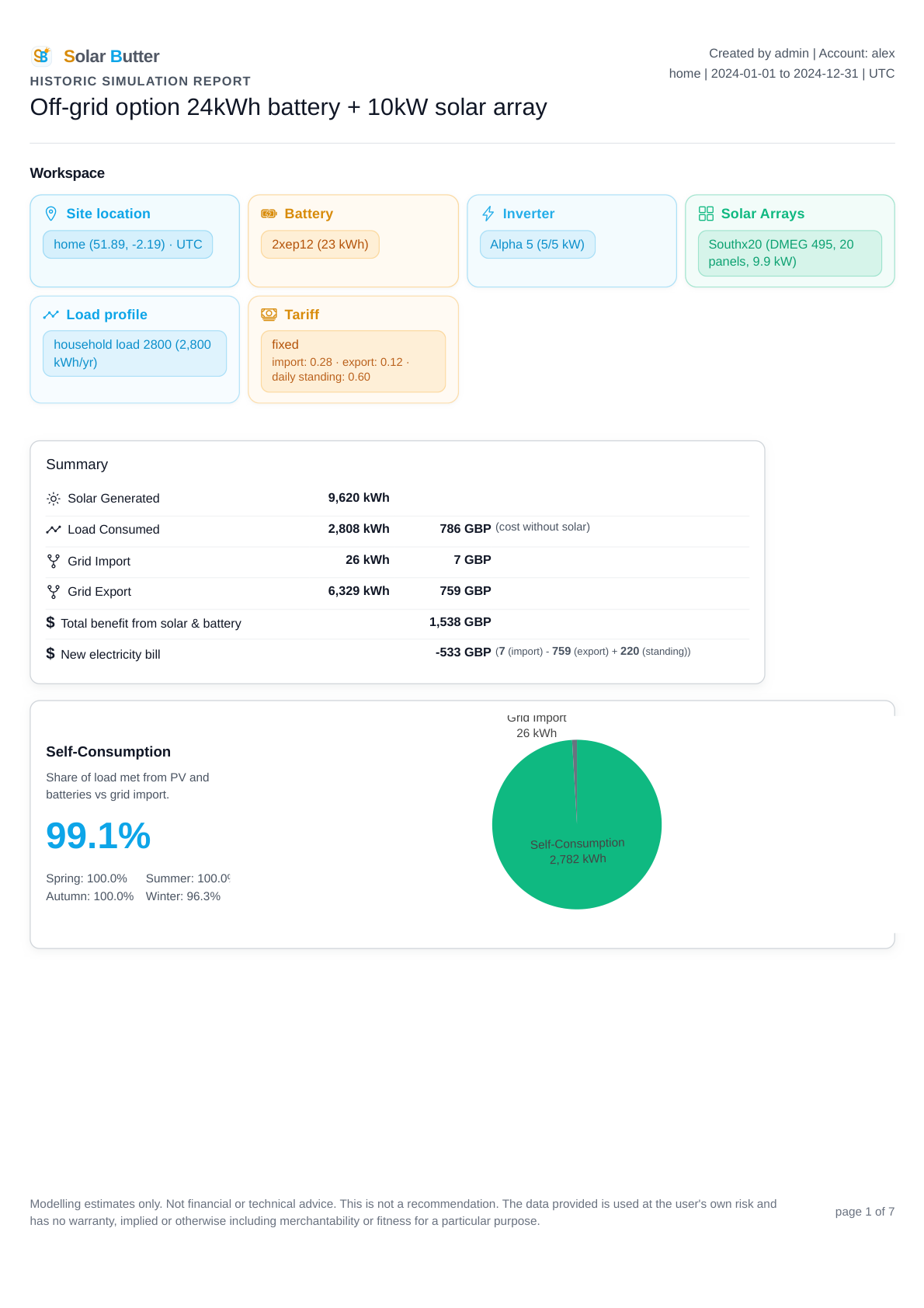
- About 24 kWh modelled battery available storage
- About 9.9 kW south-facing solar from 20 panels
- Annual household load of ~2,800 kWh
Outputs
- 9,620 kWh/year of solar generation
- 26 kWh/year of residual grid import and 6,329 kWh/year of export
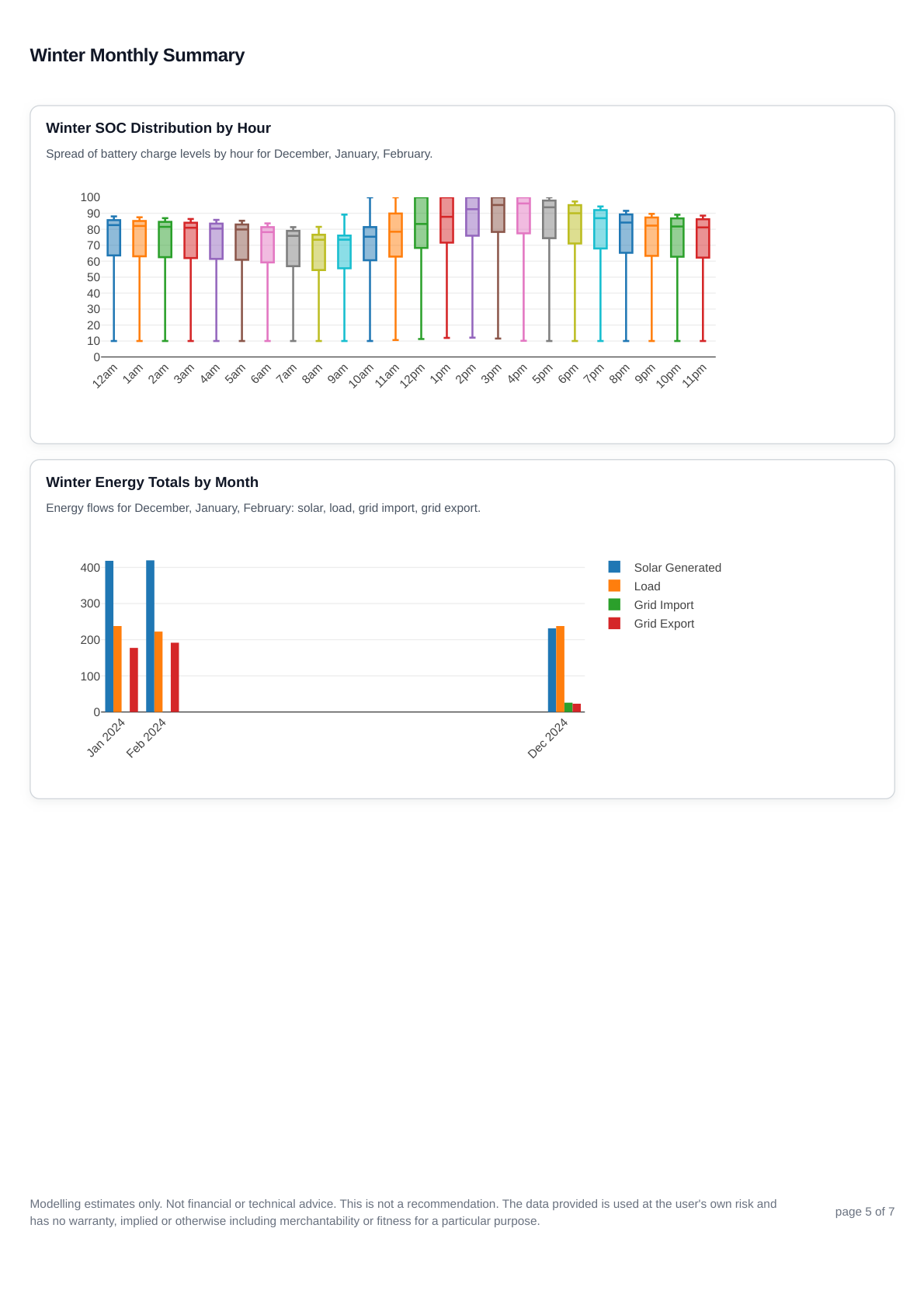
- 99.1% annual self-supply and 96.3% winter self-supply
- This is close to off-grid on annual energy, but winter still needs the largest amount of backup out of the three options
Scenario 2: 32 kWh battery and 10 kW solar
Inputs
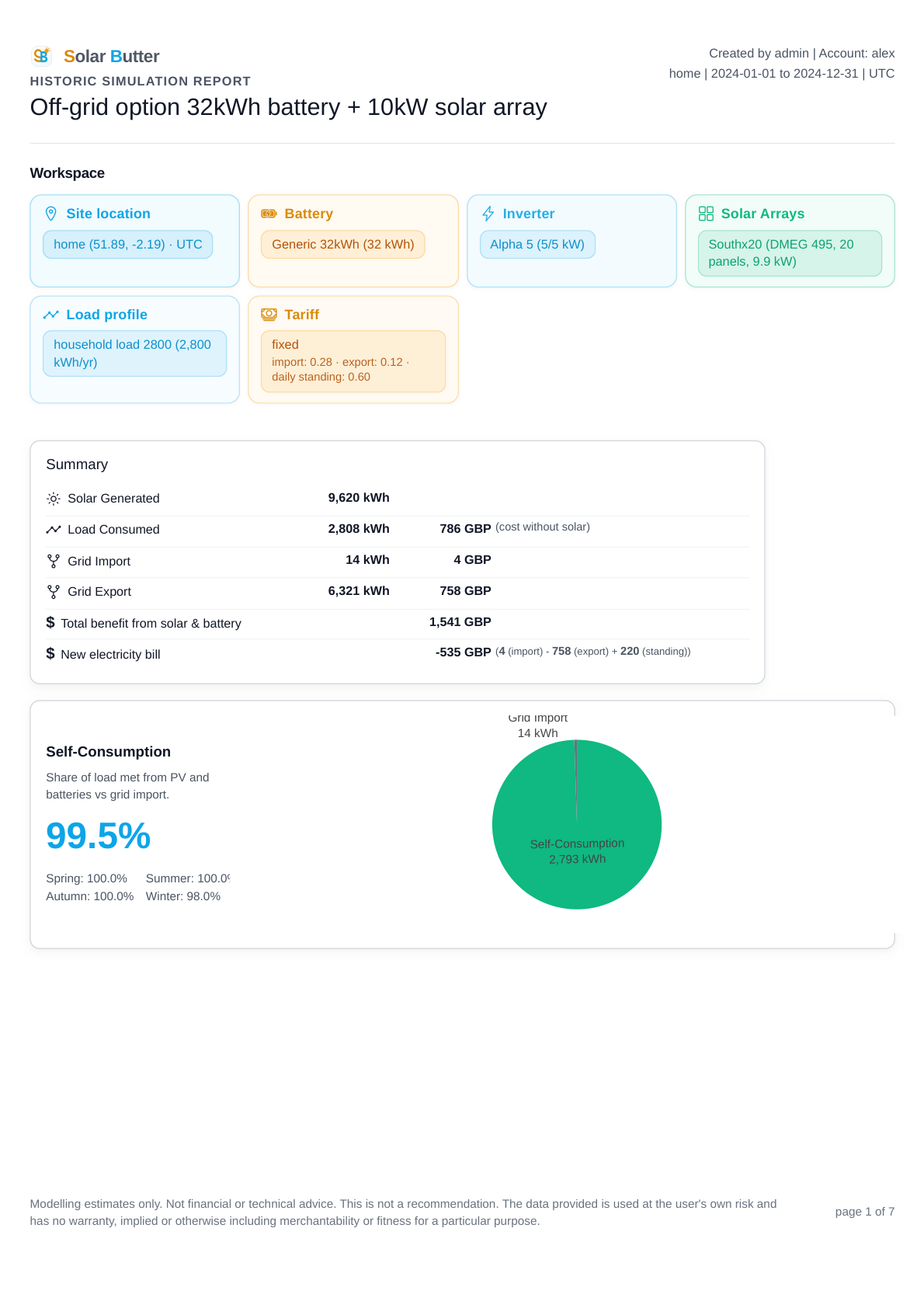
- 32 kWh battery storage
- Same 9.9 kW south-facing solar array and 2,808 kWh/year load
- The only material change from Scenario 1 is the larger battery
Outputs
- 9,620 kWh/year of solar generation
- 14 kWh/year of residual grid import and 6,321 kWh/year of export
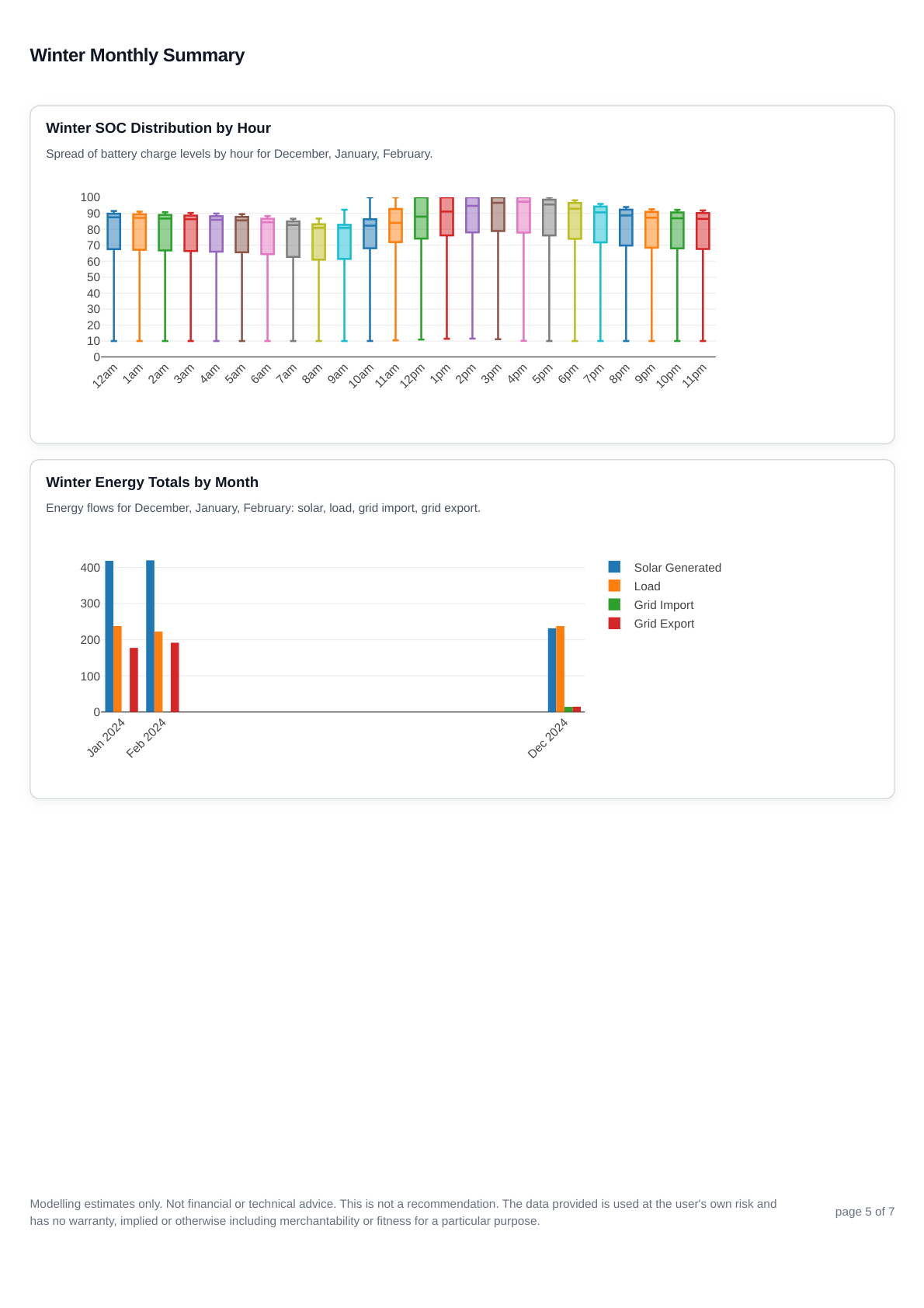
- 99.5% annual self-supply and 98.0% winter self-supply
- Extra storage improves the winter result, but the system still needs a tiny amount of backup energy in a typical year
Scenario 3: 32 kWh battery and 15 kW solar
Inputs
- 32 kWh battery storage
- About 14.9 kW south-facing solar from 30 panels
- Same 2,808 kWh/year household load and the same 5 kW inverter class
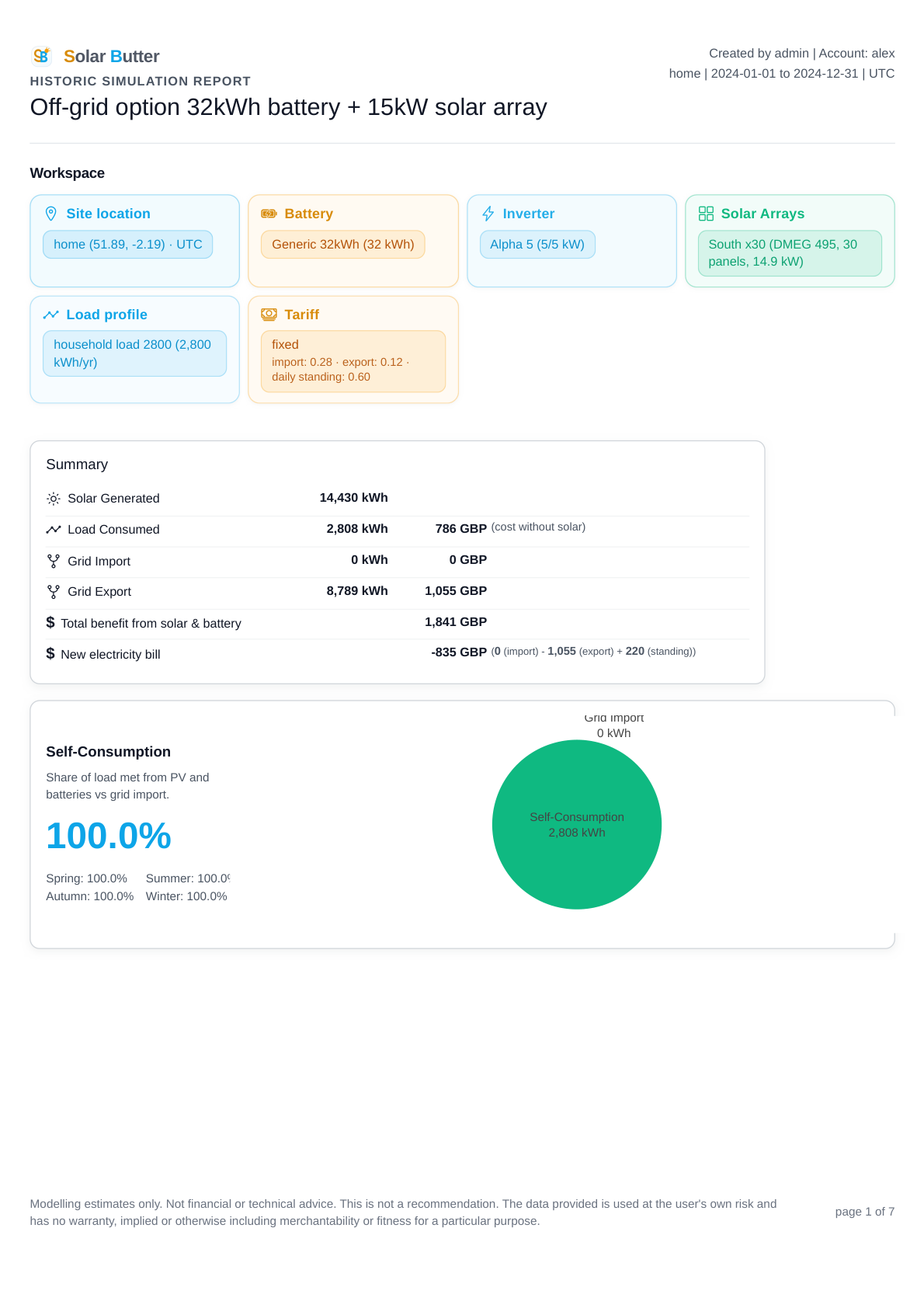
Outputs
- 14,430 kWh/year of solar generation
- 0 kWh/year of residual grid import and 8,789 kWh/year of export
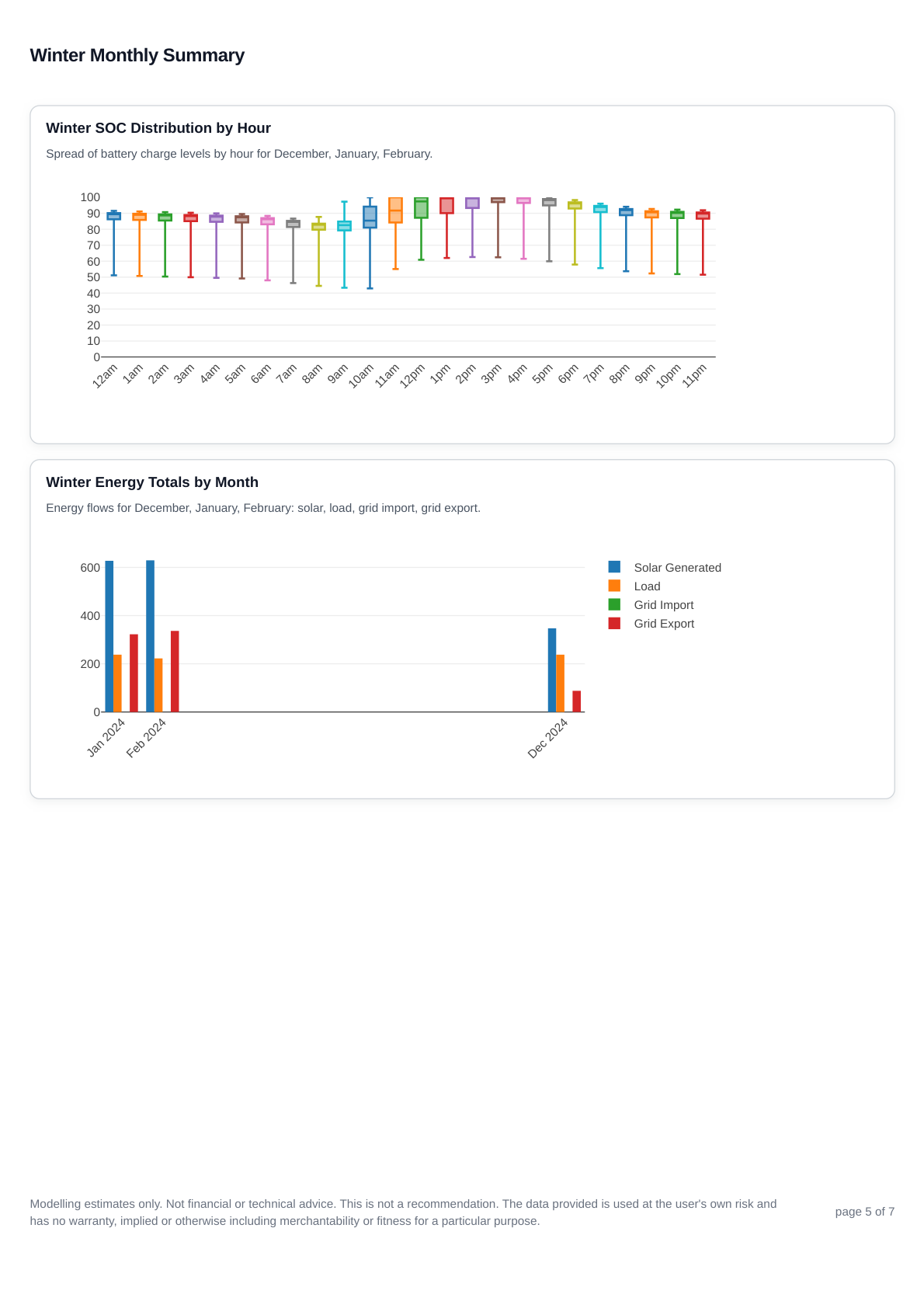
- 100% annual self-supply and 100% self-supply in every season shown in the report
- This is the first option that looks fully off-grid in the model, but it gets there by massively oversizing the array relative to the annual demand
Comparison
26 kWh/year backup gap
The smallest battery with the 10 kW array gets close, but winter still looks exposed.
14 kWh/year backup gap
More storage helps, yet it does not remove the need for occasional winter backup.
0 kWh/year backup gap
The fully covered model year only appears once the solar array grows to about 15 kW.
The table makes the trade-off clear. Battery size improves the result, but the bigger step change comes from pushing solar generation far above the household's annual use.
That means a home chasing year-round off-grid performance is likely to need a very large summer surplus just to keep winter shortages low.
| Scenario | Battery | Solar array | Annual solar | Residual import | Export | Winter self-supply | Annual self-supply |
|---|---|---|---|---|---|---|---|
| Scenario 1 | 24 kWhf | 10 kW | 9,620 kWh | 26 kWh | 6,329 kWh | 96.3% | 99.1% |
| Scenario 2 | 32 kWh | 10 kW | 9,620 kWh | 14 kWh | 6,321 kWh | 98.0% | 99.5% |
| Scenario 3 | 32 kWh | 15 kW | 14,430 kWh | 0 kWh | 8,789 kWh | 100% | 100% |
Put another way: a slightly bigger battery trims the last few imported units, but a much larger array is what finally pushes the model to zero import.
Conclusion
For a 2,800 kWh/year home, the reports suggest that going completely off-grid could be possible in a good model year, but only with a very large and oversized solar array.
The 10 kW solar array option produced far more electricity than the home uses over a year, yet they still show a small winter backup requirement of 14 kWh for a 32 kWh battery. It would be sensible to cover off that small 14 kWh shortfall with a backend generator rather than paying for an addition 5 kW of solar, which could still be unreliable in poorer winters.
These reports should be treated as an approximate sizing guide rather than a promise. Different weather years may look slightly better or slightly worse, so caution should be used before designing for zero-grid living. What's more there can be seasonal variability in consumption in reality, which is not considered in these models. For any realistic proposal this would need to be considered.
In practice, a small backup generator for winter is still recommended as the sensible safety net even if the system is sized to be off-grid for most of the year.